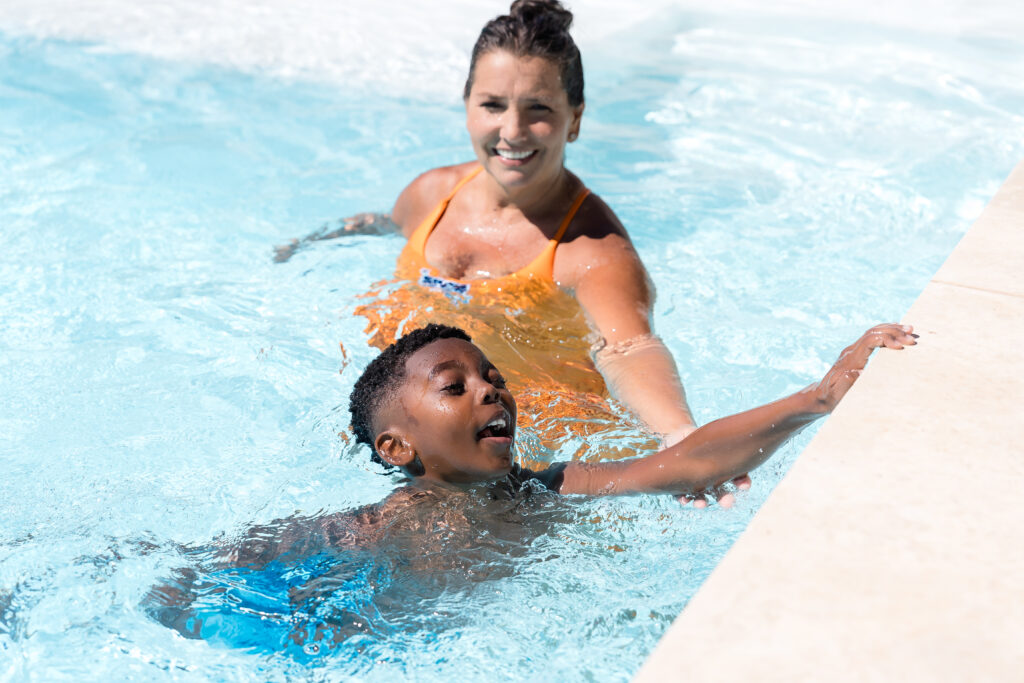
Coach Dana teaches her students from the beginning of her course that there is a safe place in a swimming pool: Where is it?
“The wall,” Coach Dana asserts, “The wall of the pool is the safe place, because it doesn’t move. It doesn’t sink. It is always there and all the way around.”
People, like water, move around. When a child (or anyone that isn’t yet confident to swim) is in a swimming pool and is just learning their swimming confidence, it is good to show them that the wall is the safest place to grab onto. Sorry parents, it is not you.
Though children should never be left alone near ANY body of water, a child learning to swim can enjoy the water without fear, as long as they know they can always hold onto the wall. This creates independent safety which builds confidence quickly.
Is there a certain way they should cling to that wall? Coach Dana says, “Absolutely!”
“Little people as well as big people should hold onto the wall with their hands only, while they keep their legs straight down and off the wall. Feet on the wall can push them away from the wall. Another reason to keep feet off the wall is we want the weight of the body creating a force downward to help the hands cling to the wall. After the grasp is right, they can, as we teach our young swimmers in class, ‘choo choo’ (like a train) around the pool as they pull themselves along. Choo choo, chug-a-chug.”
Though parents should always be near their child when they’re around water, a parent cannot be that safe place for their child. “We want little people to know that if you are not close, the wall always is. We reach for the wall, kick and scoop to the wall, climb in and out at the wall, hold a back float until we are safe at the wall and safely move around the pool with the wall.”
“An adult should never swim, for certain, in the deep end with their small child,” Dana warns, “The adult does not have access to a solid foundation, and both parent and child are in danger. One person cannot swim for two. The buoyancy ratio gets altered.”
“The rule is that if you cannot touch the ground with your feet, you should be kicking and scooping the water, or at least grabbing onto the wall if there is one.”
Who do you know that has had to jump in fully clothed to help a child? Many times it is because of the false security that arm floaties or other flotation devices create. The child does not know that they cannot float without them. (Actually they can, they just don’t know how yet.) This false security contributes to potential danger, in the fact that if for some reason a child (or parent) forgets to put the floaties on and jumps into the pool, drowning becomes a very real possibility.
“That’s why teaching your child that the wall is the safe place, and always will be a safe place is so smart,” Coach Dana confirms. “And teach this before you put floaties on. Let them experiment with their own body buoyancy at the steps, shallow end and at the wall with you close by to put them upright when they go under.”
So, as you venture out into the water; whether it’s a swimming pool or lake or ocean, remember these key rules:
- The wall (of the pool) is THE safe place.
- ALWAYS be near your children around water.
- Never hold your child if you are in water where you can’t touch the bottom with your feet.
Happy Life and Safe Swimming! See you poolside soon I hope!